

All posts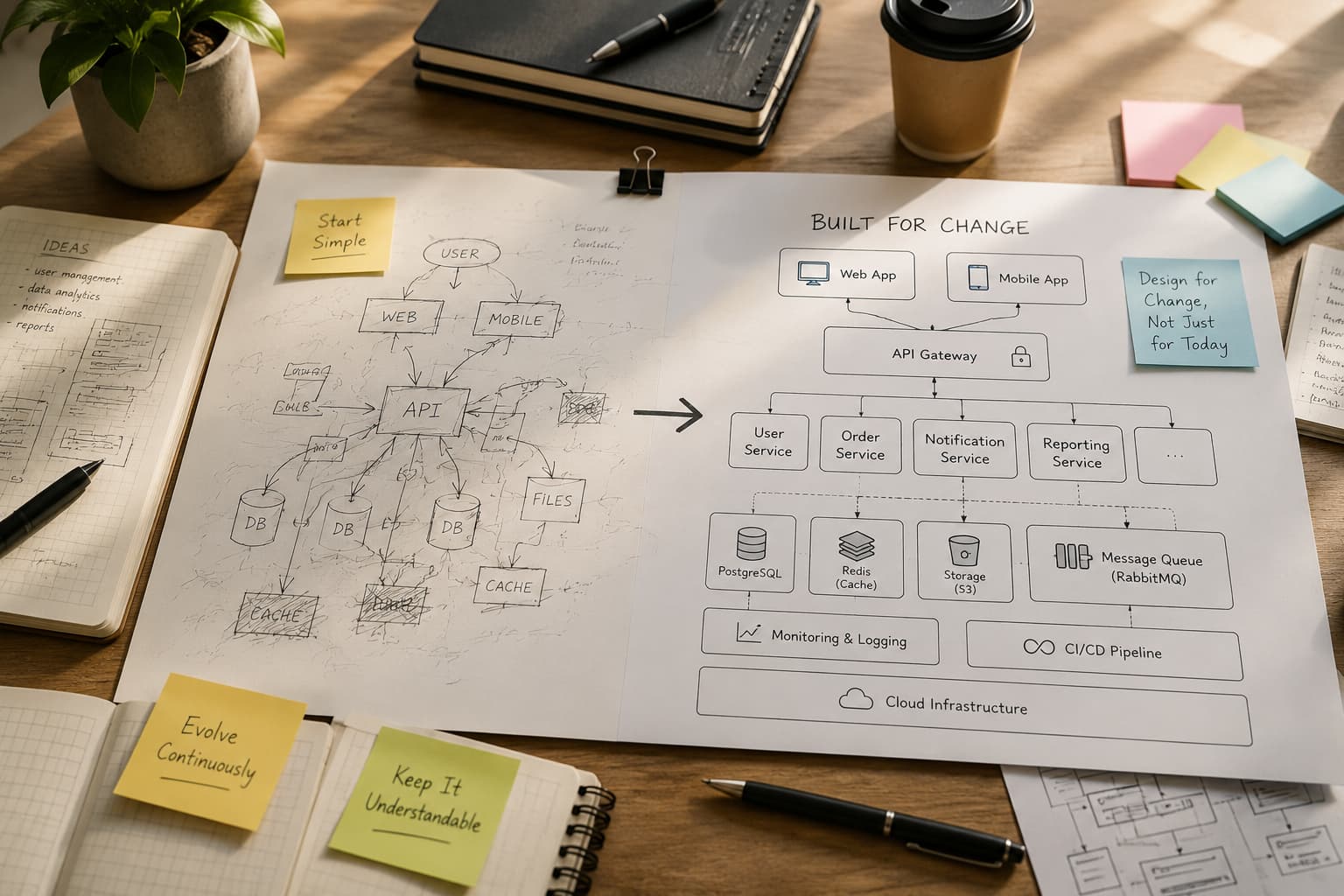

Why Good Architecture Is About Change, Not Scale
When people hear the word "architecture" in software, the conversation often turns to scale.
Can it handle a million users?
Can it process thousands of requests per second?
Can it support rapid growth?
Those are important questions, but they are rarely the first challenge most systems face.
In reality, the biggest challenge is change.
Requirements change.
Business priorities change.
Teams grow.
Processes evolve.
What seemed like a simple feature six months ago becomes a core workflow. What looked important during planning becomes irrelevant after real users start interacting with the product.
Software is constantly moving.
That is why good architecture is not primarily about preparing for massive scale. It is about preparing for inevitable change.
Over the years, I have seen systems struggle not because they were too small, but because they were too rigid.
A workflow that cannot be adjusted without touching multiple parts of the application.
A feature that requires weeks of effort to modify because it is tightly coupled to everything around it.
A simple business rule that becomes risky to change because nobody understands its impact anymore.
These problems create friction long before traffic or performance become serious concerns.
One misconception in software engineering is that more architecture automatically means better architecture.
Complex diagrams, multiple services, dozens of abstractions, and sophisticated infrastructure can look impressive on paper.
But complexity has a cost.
Every additional layer introduces maintenance overhead, learning curves, and operational responsibility.
The goal is not to build the most advanced architecture possible.
The goal is to build the simplest architecture that can support both current requirements and future change.
That balance is often where the real engineering work happens.
When we design systems, we spend a significant amount of time thinking about boundaries.
Which parts of the system are likely to change frequently?
Which parts should remain stable?
How can we isolate changes so that one decision does not create unexpected consequences elsewhere?
These questions are often more valuable than discussions about frameworks or technology choices.
Technology matters.
But structure matters more.
A well-structured system can survive multiple technology migrations.
A poorly structured system will struggle regardless of the technology stack.
Good architecture also recognizes that software exists to support people.
Developers need to understand it.
Operations teams need to maintain it.
Businesses need to adapt it.
Users need to rely on it.
If the system becomes difficult for any of those groups, the architecture is no longer serving its purpose.
The best architectures are rarely the most complicated.
They are the ones that remain understandable as the product grows.
They make change easier instead of harder.
And ultimately, that is what architecture is about.
Not predicting the future perfectly, but creating systems that can evolve when the future inevitably changes.
Written by
Hiroshi Tanaka (CTO)