

All posts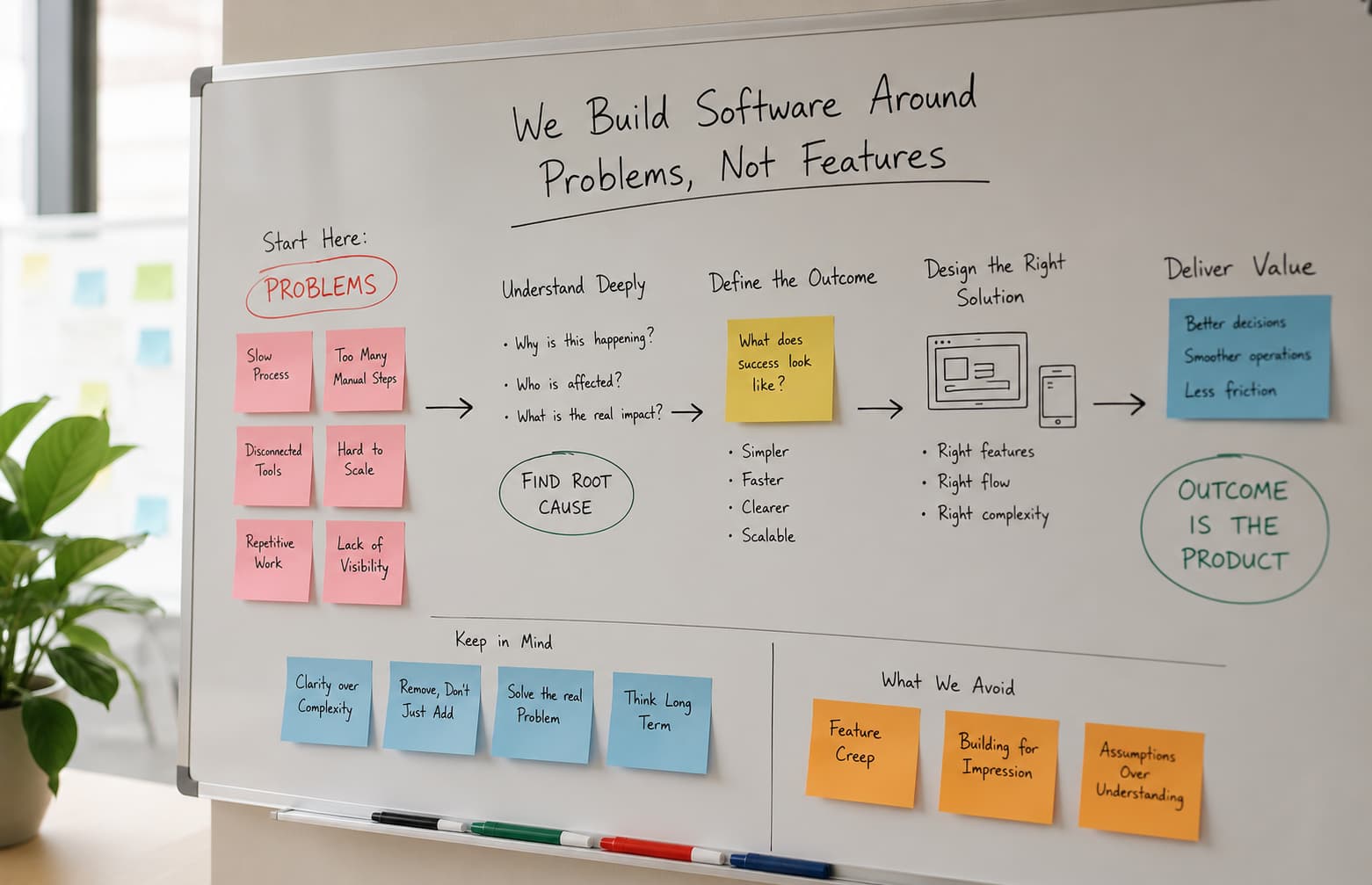

Why We Build Software Around Problems, Not Features
When people ask what kind of software we build, the answer is usually a list.
Web apps, mobile apps, SaaS platforms, ERP systems, AI solutions, cloud systems.
But the honest answer is that we don’t really start from any of those.
We start from problems.
Because in real business, nobody wakes up thinking they need a “SaaS platform” or a “custom ERP system.” They wake up thinking something is not working as smoothly as it should.
Something is slow. Something is repetitive. Something feels disconnected. Or something important is being handled in a way that doesn’t scale anymore.
That is where we begin.
Over time, I’ve noticed something interesting.
When software projects start from features, they usually become heavy very quickly.
There is a natural tendency to add more and more functionality because it feels like progress. More screens. More options. More automation. More dashboards.
But what often gets lost is clarity.
And without clarity, even powerful systems become difficult to use.
When we start from problems instead, the conversation changes completely.
Instead of asking “what should this system include,” we ask things like:
What is slowing this process down today.
Where do people spend the most unnecessary time.
What would make this feel simpler if it just disappeared.
Those questions lead to very different outcomes.
Sometimes the best solution is not a big system. Sometimes it is removing something entirely. Sometimes it is connecting two things that were never connected properly.
And sometimes, yes, it becomes a large system.
But the size is a result of the problem, not the starting assumption.
I also think modern software has become too focused on appearance in the early stage.
Everything needs to look impressive from day one. Clean UI. Smooth animations. Perfect onboarding flows.
But real usage doesn’t care about first impressions as much as we think it does.
What matters more is what happens on the tenth, fiftieth, or hundredth use.
Does the system still feel natural.
Does it still make sense under pressure.
Does it still feel like it saves time instead of taking it.
That is where software either proves itself or quietly fails.
From a company perspective, this approach is not always the fastest in the beginning.
It takes more time to understand the problem properly before building anything.
But in the long run, it reduces everything else.
Less rework. Less confusion. Less rebuilding. Less frustration from users.
And more importantly, it leads to software that people actually continue using.
At the end of the day, software is not the product.
The outcome is the product.
If the outcome is better decision-making, smoother operations, or less friction in daily work, then the software has done its job.
Everything else is just how we get there.
Written by
Oleksandr Yampolskyi (CEO)