

All work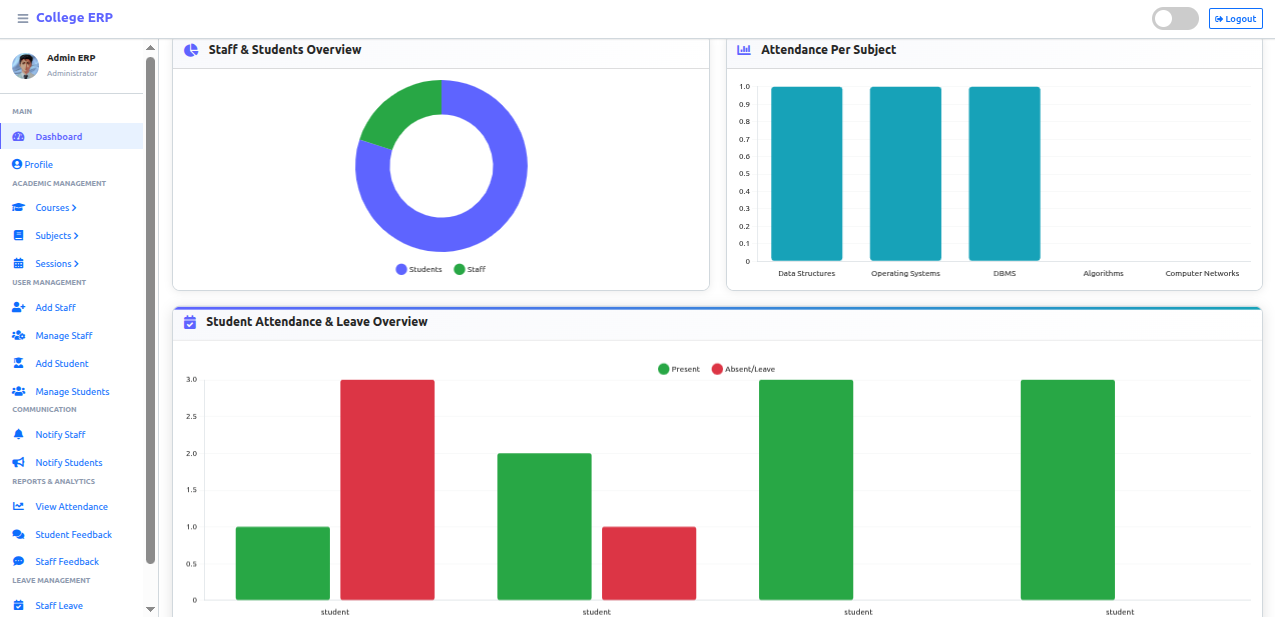
 Python
 Django
 HTML5
HTML5 CSS
CSS JavaScript
 Bootstrap
 SQLite
 PostgreSQL
 Gunicorn
College ERP — Multi-Role Management System for Educational Institutions
ERP Developmentfor ShonanStyle
College ERP is a full-stack Enterprise Resource Planning system that unifies the administrative, teaching, and student-facing operations of an educational institution into a single Django-powered platform. With three dedicated role-based portals for administrators, staff, and students, it streamlines attendance, results, leave management, feedback, and academic analytics, giving every member of a college a tailored interface backed by secure, role-aware access control.
College ERP is a comprehensive Enterprise Resource Planning system that our team built to address the operational complexity faced by modern educational institutions. Colleges juggle a continuous flow of administrative work — enrolling students, managing staff, tracking attendance, recording examination results, processing leave requests, and gathering feedback — and these processes are too often scattered across spreadsheets, paper forms, and disconnected tools. We delivered a single, unified web application, built on Python and Django, that brings all of these functions together and presents each type of user with an interface shaped specifically to their responsibilities.
At the heart of the system is a multi-role architecture that cleanly separates the experiences of three distinct user types while sharing one consistent and secure data foundation. The administrator, the teaching staff, and the student each log into the same platform but are routed to a portal designed around what they actually need to do. This separation is enforced through Django's authentication framework and role-based access control, so that sensitive operations remain available only to the users authorized to perform them, and each person sees only the information relevant to their role.
The administrator portal serves as the institution's command center. From a single analytics dashboard, an administrator gains an immediate visual overview of student and staff performance, course distribution, and subject coverage, with charts that turn raw records into actionable insight. Administrators hold complete control over the institution's core records, with full create, read, update, and delete capabilities for staff members, students, courses, and subjects. They manage academic sessions and terms, monitor attendance across the institution, review and respond to feedback submitted by students and staff, and approve or reject leave applications through a structured workflow. This concentration of oversight in one place removes the friction of coordinating across separate systems and gives leadership a real-time picture of how the institution is running.
The staff portal is designed around the daily rhythm of teaching. Through a performance dashboard, staff members can track the progress of their students and review subject-level analytics that highlight where attention is needed. Marking and updating attendance is handled directly within the portal, as is the entry and modification of examination results, so that the people closest to the students are the ones maintaining the most important academic records. Staff can also apply for personal leave and send feedback to the administration, ensuring that communication flows in both directions rather than only from the top down.
The student portal puts each learner in control of their own academic information. A personal dashboard consolidates attendance, results, and leave status into one view, so that students always know where they stand. They can monitor their class attendance records over time, access their examination results and grades through a dedicated results portal, submit leave requests when needed, and provide feedback to the head of department. By giving students direct, self-service access to their own data, the system reduces the administrative burden of routine inquiries while increasing transparency and engagement.
Security and reliability were treated as first-class concerns throughout the build. The platform integrates Google reCAPTCHA to protect against automated abuse, uses Django's mature authentication system for session and credential management, and applies role-based permissions so that every action is checked against the user's authority. Supporting capabilities such as email notifications, password reset flows, and profile management for all roles round out the experience, while the responsive front end, built with HTML, CSS, JavaScript, and Bootstrap, ensures the system works comfortably on desktops, tablets, and phones alike.
From an engineering standpoint, the application is structured for both development convenience and production readiness. It runs on a lightweight SQLite database during development and is fully prepared for PostgreSQL in production, with deployment handled through Gunicorn and static assets served efficiently by WhiteNoise. Result management is implemented using Django's class-based views, and image handling for profiles and media is managed through Pillow, reflecting a clean and maintainable use of the Django ecosystem.
The result is a robust, extensible platform that replaces fragmented administrative processes with a single coherent system, tailored to the real workflows of administrators, teachers, and students. The architecture leaves clear room for growth into areas such as online examinations, library and fee management, timetable generation, and a parent portal, making College ERP not just a solution for today's needs but a foundation that an institution can continue to build on. The project demonstrates our team's ability to translate the messy, multi-stakeholder reality of an organization into a secure, role-aware, and genuinely usable full-stack application.
Technologies used
PythonDjangoHTML5CSSJavaScriptBootstrapSQLitePostgreSQLGunicornLet’s build together
Want a result like this?
Tell us about your product and we will map a plan together.
Start a project